
At NVIDIA’s GTC Berlin keynote on October 21, one of the clearest examples of AI in engineering came from Dassault Systèmes and Volkswagen. The task looked simple on paper: adapt an existing Volkswagen Golf door design so it works on the Tiguan. How it was handled shows where product design is heading next. Instead of one engineer working through every step manually, a team of AI agents shared the job. Dassault’s agents, Aura and Leo, used NVIDIA’s Nemotron models to reason over the engineering requirements, while a coordinating harness kept context across planning, design and simulation. Aura used ENOVIA to plan the work around the vehicle’s dimensions, weight limits and other constraints. A Leo design agent picked a compatible Golf door and reshaped it for the Tiguan in CATIA. A Leo simulation agent then tested the variants in SIMULIA, accelerated by NVIDIA’s CUDA-X libraries, and uncovered a vibration problem. Those results went back to the design agent for refinement.
The final step stayed human. The engineer reviewed the refined designs and selected the one to move forward with. NVIDIA presented the workflow alongside two other reference examples, Lila Sciences in drug discovery and the Siemens Electronics Factory in Erlangen, to show how companies can build specialised agents on top of the tools they already trust. For automotive and manufacturing teams, the lesson is not that engineers are being replaced. It is that the volume of options is about to explode. When agents can produce and test design variants far faster than before, the bottleneck moves to the review: can people actually understand what they are choosing between?
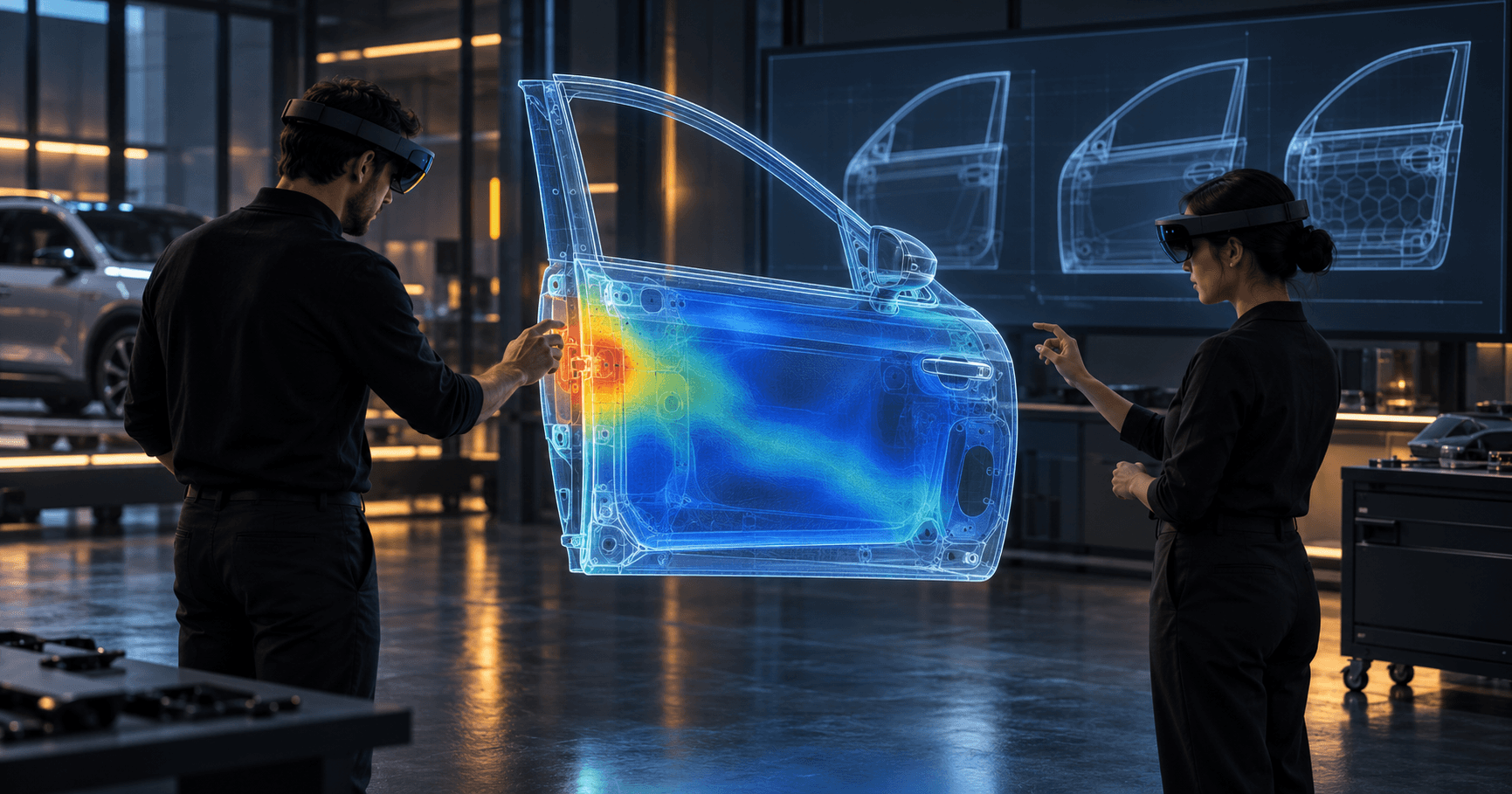
That is where immersive visualisation earns its place. Reviewing a door redesign on a flat screen is one thing. Walking around a full-scale version in VR, opening it, checking clearances, or seeing simulated vibration hotspots overlaid on the panel in AR, is quite another. Stakeholders who are not CAD specialists, from marketing to manufacturing, can join the same review and spot issues early, before tooling costs are committed. At PointZero Immersive Lab, product and design visualisation for automotive and manufacturing teams is core to what we do. As AI agents speed up how designs are created, our role is to make sure the people approving them can see, test and trust every option, at true scale, before anything is built.