

On October 28, Sony announced the ELF-MN1, a compact 6-inch Spatial Reality Display that shows 3D content to the naked eye, with no glasses or headset required. Part of Sony’s XYN spatial content line, it connects to a Windows PC or an iOS or Android smartphone with a single USB-C cable. In Japan it goes on sale on December 11 at an expected price of around ¥54,000, and Sony has not yet announced international availability.
The display works by tracking the viewer’s eyes and rendering the image in real time for that viewing position, so objects appear to sit inside the frame with genuine depth. Sony has added an infrared sensor so tracking keeps working in dim rooms, and the 403ppi panel is the sharpest in its Spatial Reality Display range. The unit weighs about 300 grams and draws 14 watts, compared with 64 watts for Sony’s 27-inch ELF-SR2. A developer SDK and plugins went live on launch day.
Sony is marketing the ELF-MN1 mainly for characters, avatars and digital figures. For businesses, the more interesting story is what a small, affordable glasses-free 3D screen makes possible.
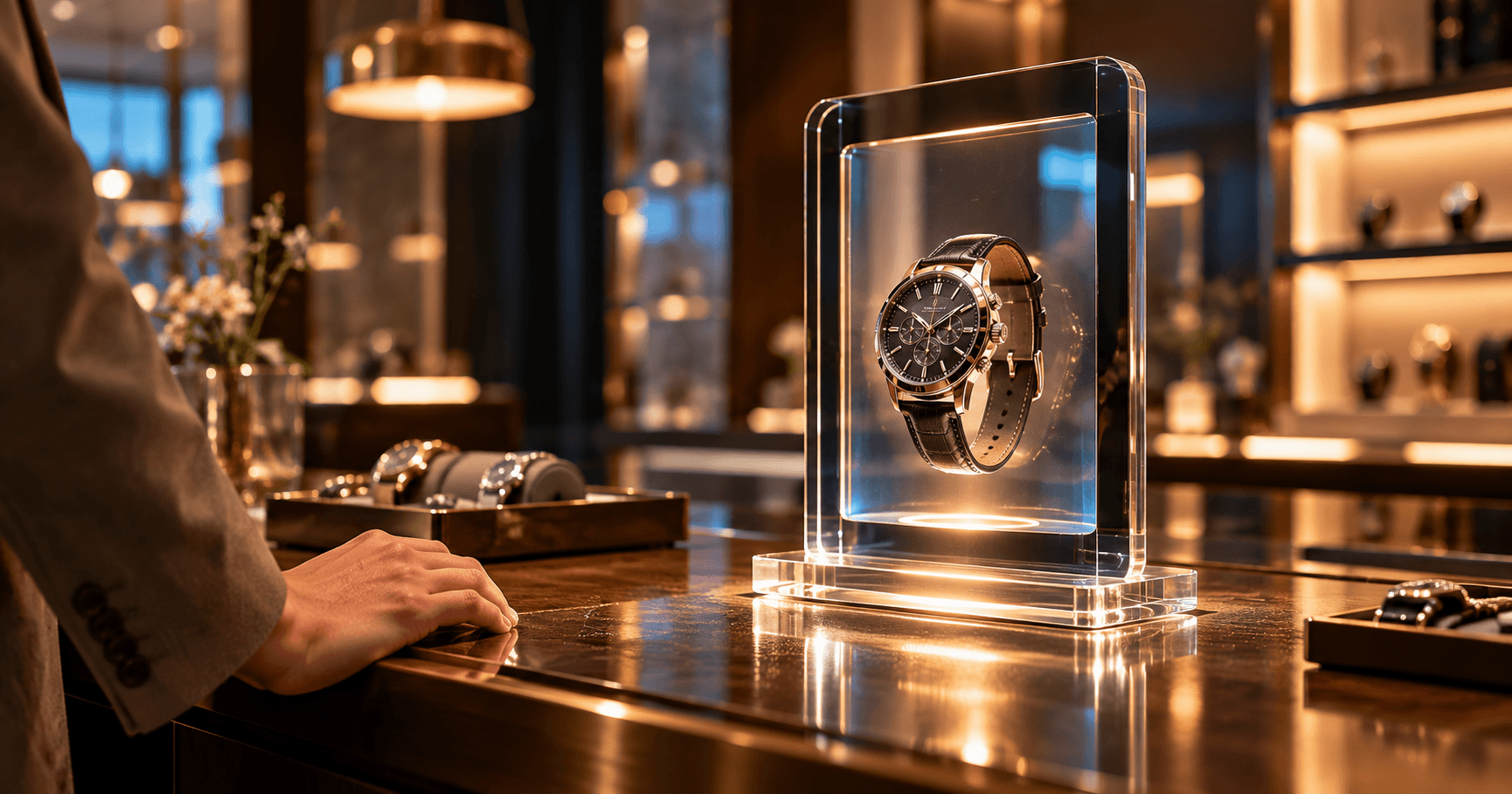
Product visualisation without friction. Not every customer wants to put on a headset or point a phone at a table. A desktop 3D display lets a buyer see a watch, a shoe or a machine part with real depth simply by looking at it.
Retail and event moments. Compact, low-power units suit shop counters, showroom plinths and trade-show booths, where visitors approach for a few seconds and headsets slow everything down.
Design reviews on the desk. Engineers and designers can glance at a 3D model’s form and proportions with real depth, right beside their main monitor.
One asset, many screens. The same well-built 3D model can power a VR walkthrough, a WebXR product viewer, an AR try-on and now a glasses-free display. That makes investing in clean, optimised 3D assets more valuable.
There are limits. Eye-tracked 3D displays like this are designed for one viewer at a time, and a 6-inch screen suits single objects rather than full environments. Treat it as a new touchpoint, not a replacement for immersive XR.
At PointZero Immersive Lab, we build 3D content once and deploy it across headsets, browsers, mobile AR and emerging displays, helping brands reach customers wherever, and however, they choose to look.