The first see-through AR glasses built on Google’s Android XR platform are now on their way to customers. XREAL began shipping AURA Founder Edition units on November 17 in the US, Canada, Japan and South Korea, with first deliveries expected in the following days. Wider markets are planned from 2027.
What AURA is
AURA is a pair of lightweight glasses tethered to a pocket compute puck. The puck pairs Qualcomm’s Snapdragon Reality Elite chipset with XREAL’s own X1S spatial coprocessor, keeping weight off the head. The glasses offer a roughly 70-degree field of view, six-degrees-of-freedom tracking and hand tracking, so digital content can stay anchored in a room rather than floating with your head. XREAL quotes factory colour calibration to 100% sRGB and 3-millisecond motion-to-photon latency.
Through Android XR, AURA can access millions of Google Play phone and tablet apps, more than 150 experiences designed for XR, and Gemini for help based on what the wearer sees. Launch pricing is $1,099 for the 256GB model and $1,299 for 512GB through December, down from $1,279 and $1,499.
Why it matters for enterprises
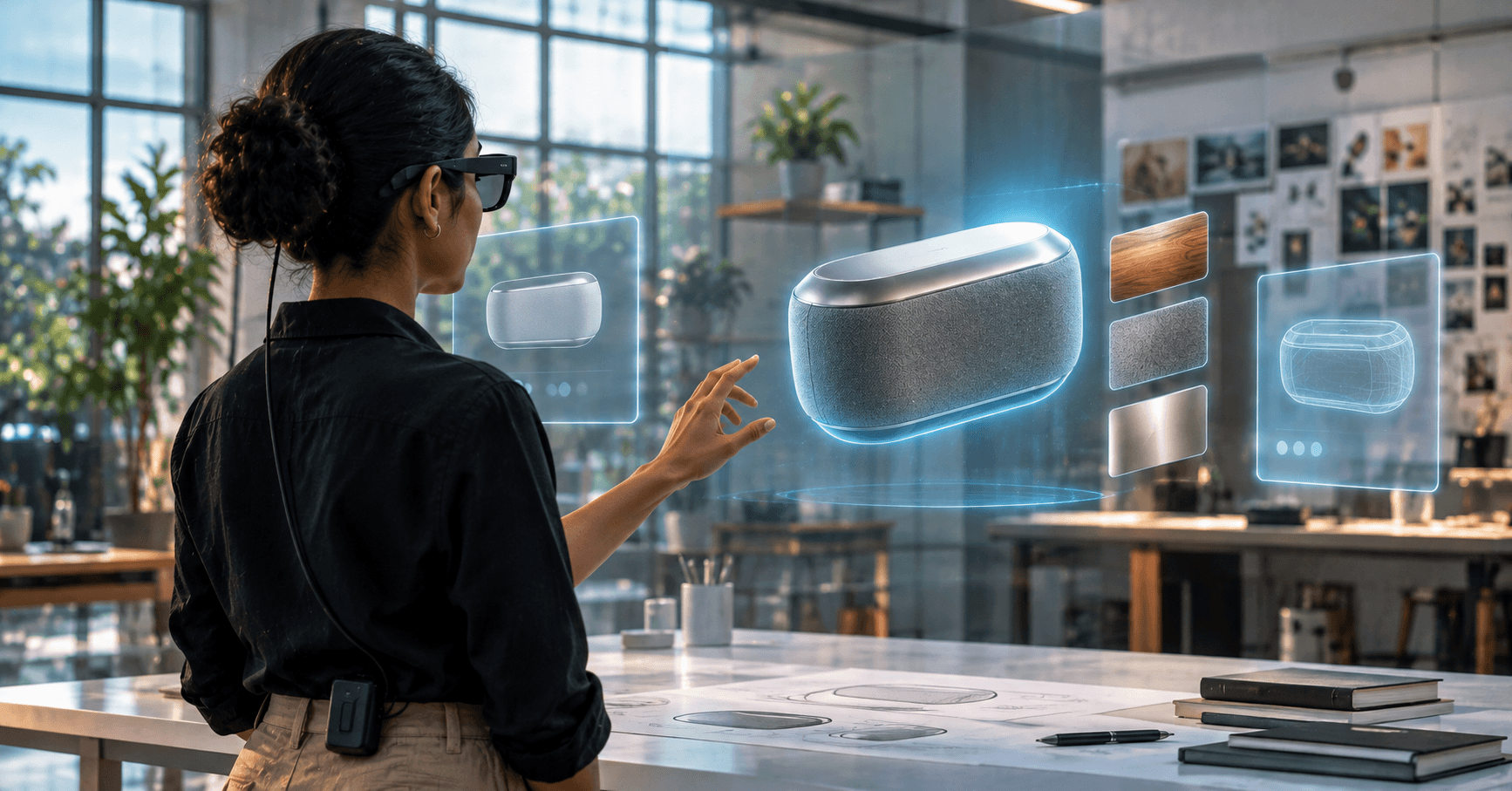
A lighter route to spatial work. Headsets remain essential for full immersion, but glasses that look closer to eyewear lower the barrier for daily use, such as reviewing 3D designs or running multi-screen workflows.
Colour-accurate product visualisation. Accurate colour and stable anchoring make AURA a candidate for showing products, materials and finishes in real spaces.
One platform, several devices. Android XR also runs on Samsung’s Galaxy XR headset and supports OpenXR, WebXR and Unity, so a single development effort can reach both headsets and glasses.
Early enterprise momentum. Integrators such as VR Expert and Treeview have announced a partnership to build custom enterprise applications for AURA.
What to watch
These are first-generation units, and the tethered puck, battery life and comfort over a full working day still need real-world testing. Shipping is also limited to four countries for now, so global rollouts will take time.
The practical next step is to identify one use case, such as a design review or sales demo, and prototype it on Android XR now, so it is ready as hardware reaches more markets.
At PointZero Immersive Lab, we build AR, VR and WebXR experiences across headsets, glasses and browsers, helping organisations test new devices like AURA with real use cases before committing to scale.