
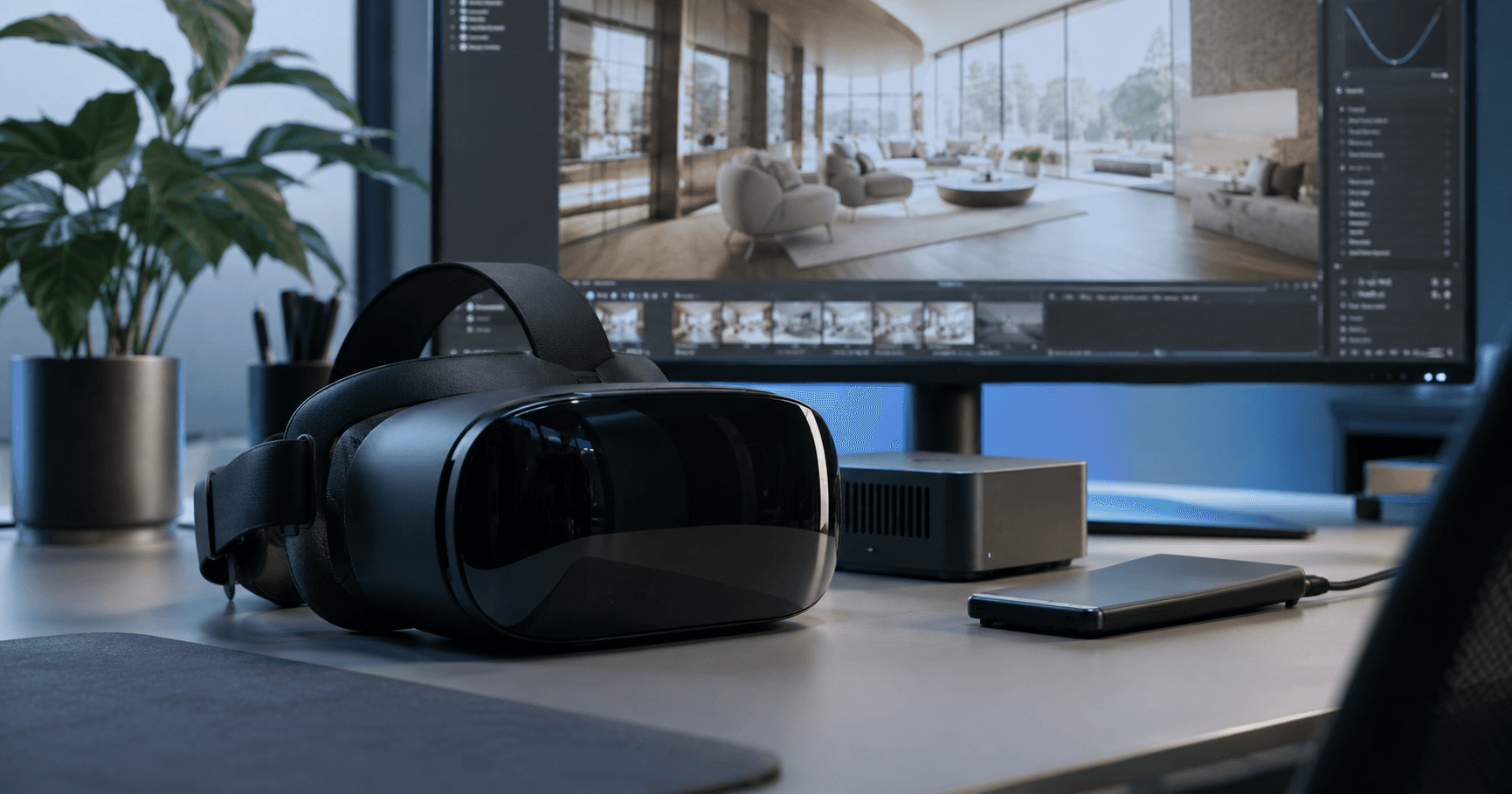
Pimax announced the Crystal Pro, a wireless PC VR headset priced at $1,399, with quantum-dot LCD panels at 2880 x 2880 pixels per eye and a 110-degree field of view. The most interesting piece is the connection option: an optional 60G AirLink kit streams the GPU's native image without Wi-Fi encoding, which targets the compression artifacts and latency that Wi-Fi streaming introduces. The headset also offers wired and standalone modes, and Pimax launched a new Spation mini-PC alongside it, plus Ringless VR Controllers and a refreshed brand identity. One practical detail to note: the headset has no built-in battery, drawing power instead from an included 16,000mAh external pack. Customers can reserve a unit today for $1.
For businesses that depend on image quality, this matters because high-resolution, wide-field headsets are where architectural walkthroughs, product design reviews, and detailed virtual tours either look convincing or fall apart. A 110-degree field of view with this pixel density gives reviewers a clearer view of fine detail and a stronger sense of scale than most standalone headsets provide, and a native-image wireless link removes one of the main reasons teams still tether PC VR to a cable. The tradeoffs are worth weighing honestly: a PC-driven headset needs a capable GPU, the external battery pack adds something to wear or carry, and a $1,399 price puts it in the professional tier rather than a fleet-purchase tier. It positions Pimax as a competitor to the recently announced Meta VR Glasses and Valve's Steam Frame, but with a very different bet: maximum fidelity over minimum weight. For design review and high-end visualization work, that bet is worth watching closely.