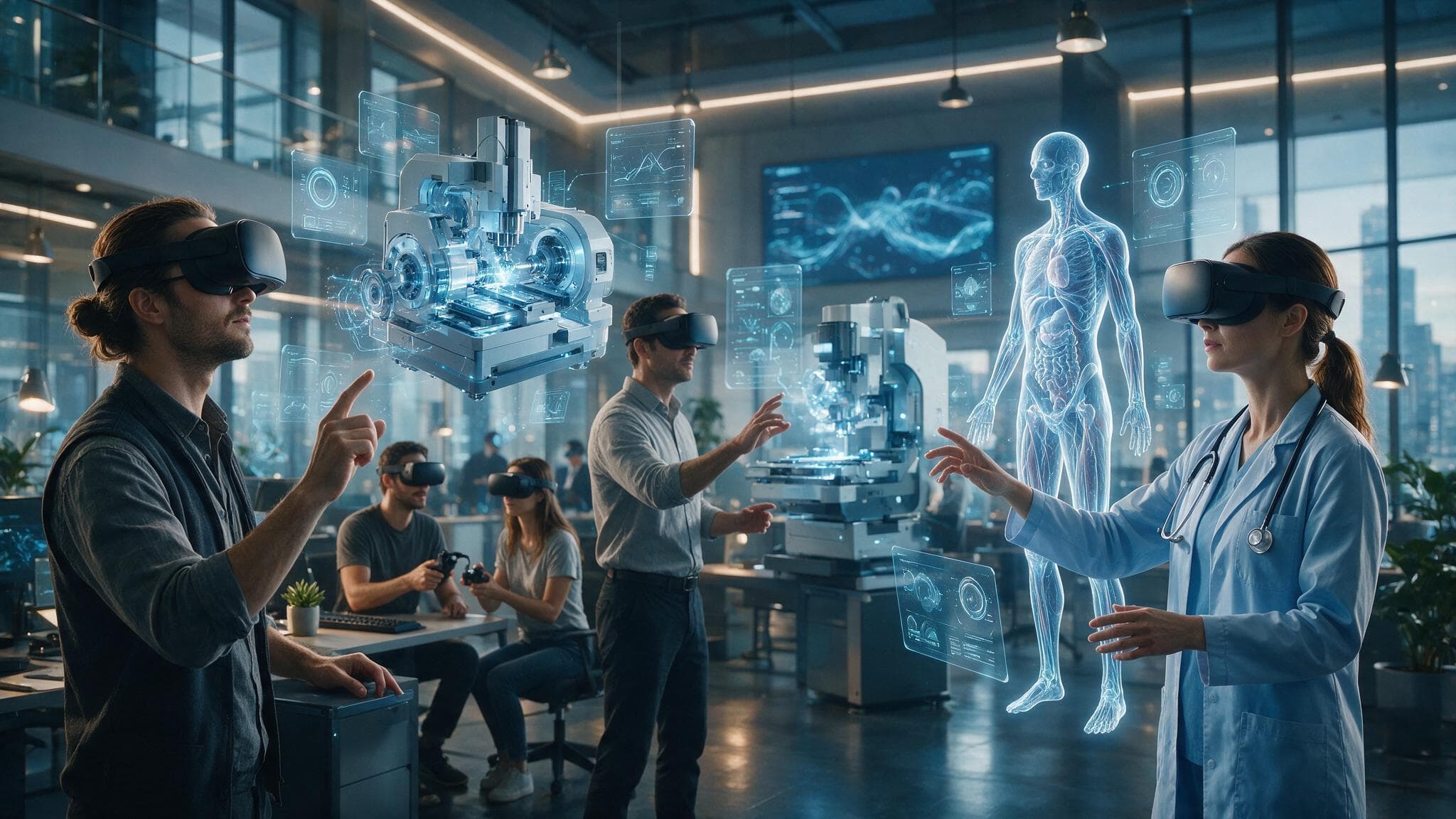


Workforce development leads all XR growth applications with 24 percent annual expansion, ahead of manufacturing at 21 percent, automotive at 19 percent, and marketing and advertising at 16 percent, according to Treeview’s 2026 spatial computing industry statistics report. The global spatial computing market itself is valued at 20.43 billion dollars in 2025 and is projected to reach 85.56 billion dollars by 2030.

Of every sector using extended reality technology today, workforce development and training is growing faster than any other, expanding at 24 percent annually, ahead of manufacturing, automotive, and even marketing and advertising. This blog treats that ranking as the headline it deserves to be, since it directly confirms what training-focused organizations across industries are already discovering, that immersive workforce development has moved from a promising pilot category into the single fastest-growing application of spatial computing technology. It opens by explaining why training specifically is outpacing every other sector, walking through the structural reasons this makes sense, including that training is one of the few business functions where the value of repetition, safe failure, and standardized measurement is universally recognized across nearly every industry, from healthcare to aviation to retail. The piece covers what is actually driving this growth on the ground, including rising demand for scalable onboarding as workforces become more distributed, growing recognition that VR-based training produces measurably faster skill acquisition and fewer on-the-job incidents than traditional methods, and increasing comfort among training and safety leaders with immersive technology as more of their industry peers publicly adopt it. It connects this workforce development growth to the broader spatial computing market trajectory, noting that the overall market is on track to more than quadruple from just over 20 billion dollars in 2025 to over 85 billion dollars by 2030, meaning the businesses building a training strategy around XR today are entering during a genuine growth phase rather than a mature, saturated market.
A section will address what this growth rate means practically for organizations still deciding whether to invest, arguing that a 24 percent annual growth rate in a specific application category signals strong, repeatable proof of value rather than speculative hype, since growth this concentrated in one use case typically reflects real organizations achieving real, measurable results and reinvesting accordingly. The blog also touches on how this growth breaks down across different training contexts, covering onboarding acceleration, safety and compliance rehearsal, technical skill development, and soft skills or communication training, each representing a distinct but related driver of the overall category’s expansion. Immersive workforce training, XR training market growth, and enterprise VR training adoption are the throughlines here, framing the data not as an abstract industry statistic but as a clear signal about where training budgets are already flowing and why.